The digital format of a CD became public in 1980 with the first commercial CD player being created by Sony in 1982 released in Japan. The Sony CDP - 101 became available in worldwide in 1983. CD's where rising but still seen as a niche until the British rock band Dire Straits released their "Brothers in Arms" album alongside their new tour sponsored by Philips to advertise the CD format. The album was the first time a CD had outsold the vinyl format. This is seen as the album which kick started and made CD sales skyrocket. The sales quickly overtook vinyl and in 1991 overtook cassettes and became the leading form of distributing media.

 Monetizing music had already become harder due to digitization so artists and bands thought of new ways to earn money such as Merch and special editions of physical formats as seen with the Slayer example of limited edition Vinyl (as seen by the example on the left). It became more mainstream to have a promo package/digipak as it was harder to earn money from streaming. Streaming has caused controversy through low payment rates. Artists and Bands just aren't earning the same amount of money for streams than from previous singles or album sales on CD. It doesn't help that 80% of all music sales in the global industry go back to the big 3 as they are the ones profiting the most from streaming. It is calculated that Spotify (the largest paid streaming service for music) pays the artist $0.003 to $0.0084 per stream depending on a few variables. This is significantly less than what was earned before with an artist earning about $0.12 per single sale on CD's.

Rise and Fall of CD sales
CD sales kept rising and rising with some experts claiming "indestructible industry" it rose to over 1 billion sales worldwide in early 90's all the way up to 2 billion in the mid 90's. Part of the reason for this was because people had bought 1 album on vinyl, then bought them on cassette and final bought the same album on CD. Artists and Bands had convinced many people to buy the new format as it became mainstream. The industry was booming. The big three where getting huge profits.
 |
| CD Sales from 1991 to 2015 (in millions) |
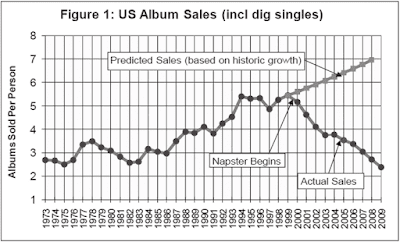
There where people who predicted there would be a fall and who where developing the fully digital format know as MP3. This could be downloaded from the new world of the internet. Peer to peer file sharing became available with the launch of Napster in 1999. The online distribution method being so easy to access and free led to the first decline of CD sales. The highest selling point of this new form of distribution through Piracy was that it was free, and you could access it anywhere.The physical media format was disrupted by the digitization/convergence of the new age of Web 2.0.
The iPod
The invention of the iPod in 2001 also greatly affected the physical media sales. The sheer difference in size making this device extremely portable compared to the previous mainstream portable music player of the Sony Walkman. The iPod also had a whopping 5GB flash drive as storage which was huge compared to the other MP3 players at the time. Another major factor was the MP3 format, you didn't have to bring other physical media with you or chose which album you wanted to listen to before your commute as they where all downloaded onto the iPod. iTunes was introduced alongside the iPod which became the largest market place for digital media quickly. It was also easy to rip previous CD's and download them to your iTunes library. “Before that the MP3 was an inferior good, “Once you had the iPod, the CD was an inferior good. It could get cracked or lost, whereas MP3 files lasted.” Quote from Stephen Witt. The impact wasn't large until smartphones where introduced in 2005 when people really began to exploit the piracy sites. The release of the iPhone was what made iTunes extremely popular.

Streaming
With the fall of CD sales and the rise of digital media through web 2.0/convergence and digitization, there was way of listening to music bound to arrive. YouTube was founded in 2005 and set the benchmark for streaming to come. Streaming was a legal and (sometimes) free way to access media and music across all devices with an internet connection. YouTube to date has over 1.5 billion registered accounts with the largest music specific paid for streaming service Spotify (launched in 2008) having 87 million users subscribed with an estimate of 5 times more people using the free version. Streaming overtook global revenues for the first time in 2017 to become largest source of revenue for the global music industry. Streaming became the new mainstream and easiest way to listen to music still at a decent quality.


Digipak/Monetization
With the fall of CD sales and the rise of digital media through web 2.0/convergence and digitization, there was way of listening to music bound to arrive. YouTube was founded in 2005 and set the benchmark for streaming to come. Streaming was a legal and (sometimes) free way to access media and music across all devices with an internet connection. YouTube to date has over 1.5 billion registered accounts with the largest music specific paid for streaming service Spotify (launched in 2008) having 87 million users subscribed with an estimate of 5 times more people using the free version. Streaming overtook global revenues for the first time in 2017 to become largest source of revenue for the global music industry. Streaming became the new mainstream and easiest way to listen to music still at a decent quality.


Digipak/Monetization
 Monetizing music had already become harder due to digitization so artists and bands thought of new ways to earn money such as Merch and special editions of physical formats as seen with the Slayer example of limited edition Vinyl (as seen by the example on the left). It became more mainstream to have a promo package/digipak as it was harder to earn money from streaming. Streaming has caused controversy through low payment rates. Artists and Bands just aren't earning the same amount of money for streams than from previous singles or album sales on CD. It doesn't help that 80% of all music sales in the global industry go back to the big 3 as they are the ones profiting the most from streaming. It is calculated that Spotify (the largest paid streaming service for music) pays the artist $0.003 to $0.0084 per stream depending on a few variables. This is significantly less than what was earned before with an artist earning about $0.12 per single sale on CD's.
Summary
The music industry boomed in the 80's and had the largest revenue with a total of over $38 billion at the end of the 20th century. A figure that is yet to be touched since.
...
Vodcast to go here
...


